
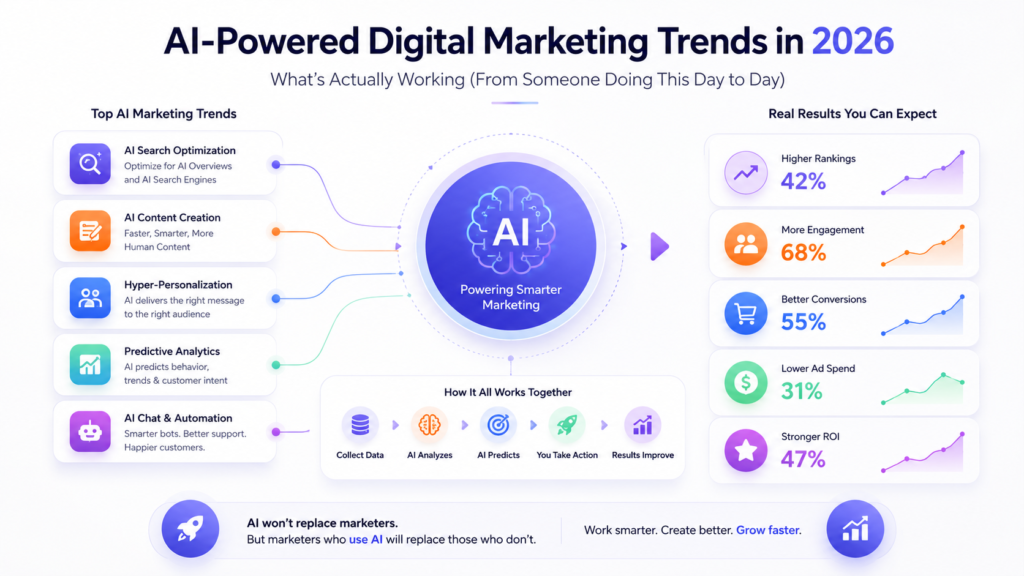
I want to talk about the digital marketing trends in 2026. If you have been looking at LinkedIn this year, you have probably seen a lot of posts saying that artificial intelligence has changed everything about marketing.
Some of these posts are just saying things to get attention. Some of them are true. I work with intelligence every day as a freelance marketer. I have been doing this for two years now. I can tell you that the truth is not as simple as what you read in the headlines.
This post is about the digital marketing trends in 2026 that I think you should know about. I will talk about how things have changed in the way we make content and how search works. I will also talk about how people like me, freelancers and small teams, can use intelligence to our advantage.
Digital marketing trends in 2026 are really interesting. I will share what I have learned. I will also talk about some mistakes that you can make if you start using intelligence too quickly. Digital marketing trends in 2026 are what I want to focus on.
Why 2026 Feels Like a Turning Point for Digital Marketing Trends in 2026, Not Just Another Update:
Marketing has absorbed new tools before. What makes this year different is scale. Digital marketing trends in 2026 are being shaped by AI adoption at an unprecedented pace. Recent industry data shows that a large majority of marketing leaders now say AI has meaningfully improved productivity and strategic execution, and teams using AI across multiple functions are reporting output gains well above those still working without it.
Adoption has moved past the experimental phase; generative AI is now a regular part of daily work for most marketing organisations. This shift is one of the biggest digital marketing trends in 2026, not a side project.
That shift matters because it changes the baseline. When most of your competitors are using AI to draft content, analyse data, and manage ad bidding, “using AI” stops being a differentiator.
What separates people who benefit from it and people who just generate more noise is how thoughtfully they use it. That’s the lens I want to bring to the rest of this post.
The AI Marketing Trends 2026 Is Actually Built Around
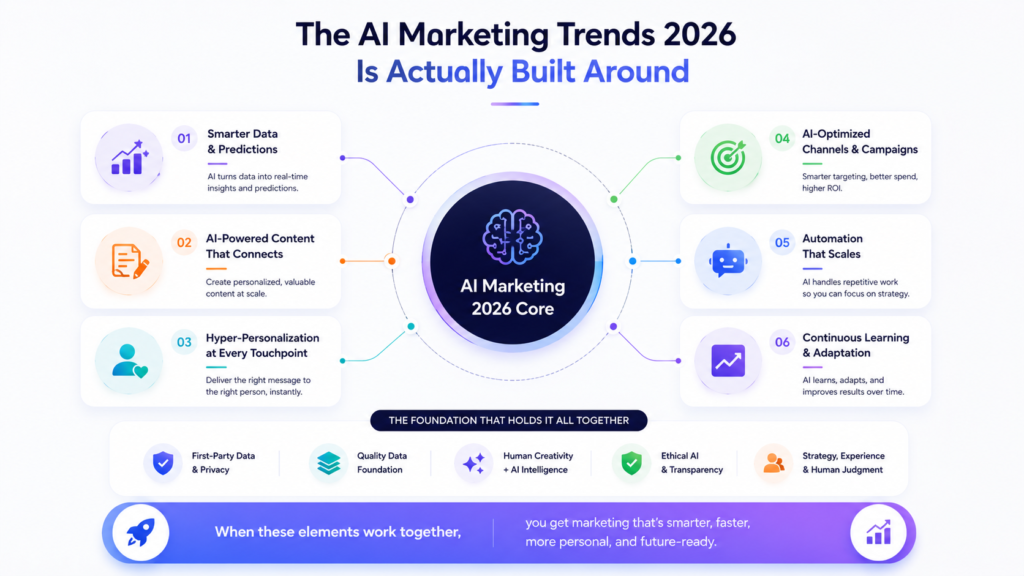
Here are the shifts I’d put at the top of the list if you’re planning your strategy for the rest of the year.
1. AI Search Optimization Is No Longer Optional
This is the one I’d flag first, because it changes how you should be writing content, not just what tools you use to write it.
Google’s AI Overviews and AI Mode now shape a large share of search results, and the company published its first official guidance on optimising for AI search in mid-2026. The core idea is straightforward: your content is now being read by two audiences, the traditional ranking algorithm and the AI systems that scan a page, extract a claim, and decide whether to cite you.
Practically, that means:
- Leading with a direct, clear answer near the top of a section, then supporting it with detail
- Using question-based subheadings that map to how people actually ask things
- Backing claims with specific numbers, named sources, and dates rather than vague statements
- Adding structured data (FAQ or How-To schema) so machines can parse your content cleanly
I’ve started treating every post the same way: assume a chunk of readers will never click through and will only ever see a summarised version of my answer inside an AI response. That reframes “good content” as content that holds up even when it’s stripped of its formatting and quoted out of context.
2. AI Content Tools Have Changed the Economics of Freelance Marketing
I have seen this trend firsthand. AI writing and content tools have not replaced the thinking that clients pay me for. They have completely changed how I use my time. This is one of the biggest digital marketing trends in 2026. Now I spend time editing and structuring and less time drafting.
AI content tools have really changed things. Marketers who use AI tools regularly say they save hours a week. The experienced marketers save the most time. This is probably because they know how to use AI tools and catch mistakes. Among the leading digital marketing trends in 2026, AI-assisted content creation continues to stand out.
Companies that use AI tools also publish more content each month than those that do not. From my experience I can say that AI content tools only save time when you have a good editing habit. When I first started using AI drafting tools, I actually spent more time fixing problems than I saved on writing.
It was not until I got specific about voice and examples that the tools started to work. This is something to remember: AI content tools are a tool that helps your skills, not a replacement for them. This practical shift is shaping digital marketing trends in 2026 across businesses of all sizes.
3. Agentic AI Is Starting to Run Campaign Pieces, Not Just Tasks:
This year I have seen a change in AI. AI is now doing campaigns, not just small tasks. This is one of the most important digital marketing trends in 2016
AI can now do things like research, testing and budgeting with less help from people. Google’s Performance Max and Smart Bidding are examples of this.
For marketers and small agencies, this is something to watch closely. Now a one-person operation can manage a sophisticated paid campaign. This shift is changing how businesses approach digital marketing trends in 2026.
You need to understand the strategy well enough to know when the automation is not working correctly. To succeed with digital marketing trends in 2026, marketers need to combine AI automation with human judgement.
4. “Machine Customers” Are a Real Planning Consideration Now
This may sound like something from the future. It is already happening, and it is becoming one of the emerging digital marketing trends in 2026.
AI shopping assistants are starting to research and complete purchases on behalf of users. Some forecasts say that this kind of AI-mediated buying will be a part of revenue in the next couple of years.
For small businesses this is not a big deal yet. It is worth understanding: product data and clear specifications are becoming more important. As digital marketing trends in 2026 continue to evolve, businesses with well-structured product information will have an advantage. AI agents need easy-to-understand information, not persuasive writing.
5. Zero-Click Search Is Reshaping What “Success” Looks Like
Traffic loss from AI-generated answers is real. Some estimates say that organic traffic reductions from AI overviews are as high as 20 to 40 per cent for query types. This is a number to accept if your entire strategy is built around click-through traffic.
I have had to change my mindset. Being the cited source in an AI answer without a click still has value. It builds trust and recognition over time even when it does not show up in a traffic report.
I have started tracking brand mentions and citations, not clicks as a success metric, for content. I would encourage freelancers and small marketing teams to do the same
A Quick Comparison: Traditional SEO vs. AI Search Optimization in 2026
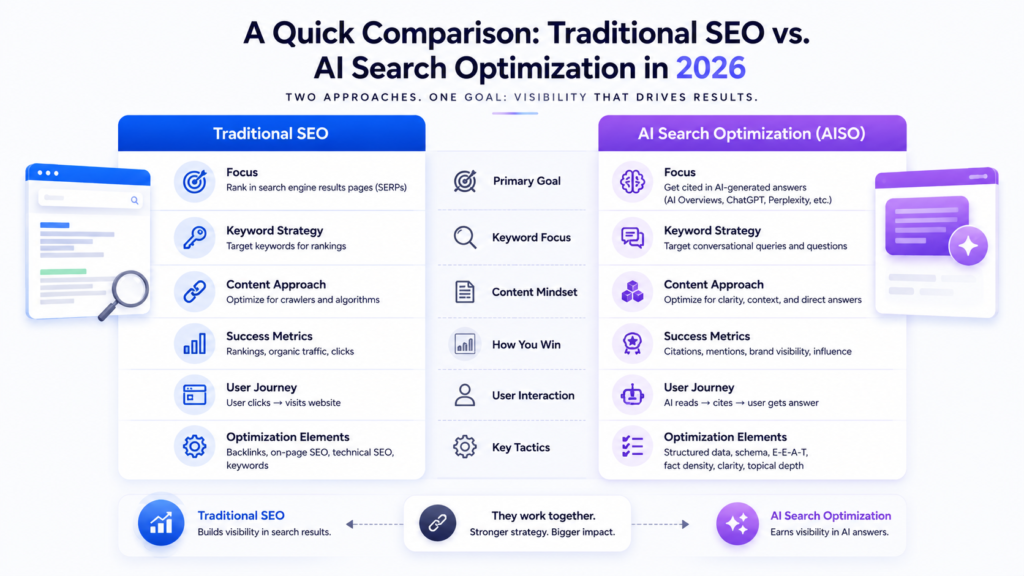
| Factor | Traditional SEO | AI Search Optimization (AEO/GEO) |
| Primary goal | Rank in top 10 blue links | Get cited inside the AI-generated answer |
| Content structure | Keyword-optimized headings | Question-based headings, direct answers up top |
| Success metric | Click-through rate | Citation frequency, brand mentions |
| Key trust signal | Backlinks | Structured data, fact density, named sources |
| Content lifespan | Refresh yearly | Refresh every 3 to 6 months |
Neither approach replaces the other. Good AI search optimisation is still based on the basics of search engine optimisation. These basics include things like content, a clear website structure and real expertise in an area. Think of intelligence search optimization as an extra layer on top of these search engine optimization basics, not something that replaces them
Common Mistakes I See Marketers Make With AI Right Now
I notice some things that happen over and over when I work with clients and talk to people who do what I do.
For example,
1. Marketers are publishing AI drafts with little editing:
You can tell when this happens; it sounds like it was written by a machine. It can actually hurt the trust people have in you more than it helps you get your message across.
2. Some marketers are not even using AI answer engines at all:
They are still trying to get their websites to show up high in the search engine results, and they are missing out on the fact that more and more people are seeing things in other places now.
3. Marketers are also treating every AI tool this way:
Just because one tool is good for writing the draft of something does not mean it is good for writing the final version that you show to clients. The other way around is also true.
4. Marketers are not checking to see if AI tools are really making things better: Just because you save time does not mean you get results. You should be measuring both things to see what is really happening with artificial intelligence tools.
A Simple Framework for Adopting AI Without Losing Your Edge
If you are a freelancer or a small team trying to find your way, here is the way I follow:
- Check your work process first: find out which tasks are done over and over again and don’t need thinking (like formatting, first drafts and data summaries) and which need real planning and thinking. Start by making the first group easier with automation before you even think about the group.
- Master one AI writing tool instead of trying five that don’t truly help.
- Make sure you always have a check for anything that was helped by AI before you share it: Focus on making sure it is correct and sounds right. Is specific.
- Include AI search optimisation in your content list: give direct answers at the top, use question-based headings and add schema markup when it makes sense.
- Keep track of how many times you are mentioned by others and how many times your brand is talked about: not just how many clicks you get. This way you are not guessing as search habits change.
Frequently Asked Questions
Q. What are the top digital marketing trends in 2026?
A: AI search optimisation (AEO/GEO), agentic AI managing multi-step campaigns, AI-assisted content production, and a shift toward brand-mention tracking over pure click metrics are the trends with the most practical impact right now.
Q: Is artificial intelligence search optimisation different from search engine optimisation?
A: Definitely. Think of artificial intelligence search optimisation as part of search engine optimisation, not something that takes the place of search engine optimisation.
While regular search engine optimisation helps your website show up in search results Artificial intelligence search optimisation helps your content be chosen and used in answers created by artificial intelligence.
The main thing about artificial intelligence search optimisation is making sure your content is organised well and is reliable.
Q: Do I need tools to keep up with artificial intelligence marketing trends in 2026?
A: No. In fact, many of the changes do not cost anything at all. Small changes like answering questions and making your content easier to understand and adding The ‘Asked Questions’ schema can have a big impact on artificial intelligence marketing.
It is more about how you make content for artificial intelligence marketing than how much money you spend on artificial intelligence marketing.
Q: Will artificial intelligence replace freelance marketers?
A: I do not believe that will happen. Artificial intelligence is good at making tasks, but artificial intelligence cannot take the place of human creativity or planning or building relationships.
The freelance marketers who use artificial intelligence as a tool. Rather than trying to fight against artificial intelligence. They are the ones who will do best in artificial intelligence marketing and as freelance marketers.
In summary:
The thing about digital marketing trends in 2026 with AI is that it is not necessary to use every new tool that comes out. AI is reshaping digital marketing through two key shifts.
The first change is how digital marketing content gets made. The second change is how people find marketing content. If you remember one thing from this post, remember this: you should get into the habit of editing marketing content made with AI instead of ignoring it.
You should also start taking marketing search visibility with AI very seriously, just like you always took traditional rankings seriously. For me and the other digital marketing people I talk to, doing these two things is what is really making a difference in marketing with AI.